Business
Leadership wanted a fast, visible win. Screen aware AI had to prove it saved minutes, not just look impressive. Any feature had to work across all four channels.
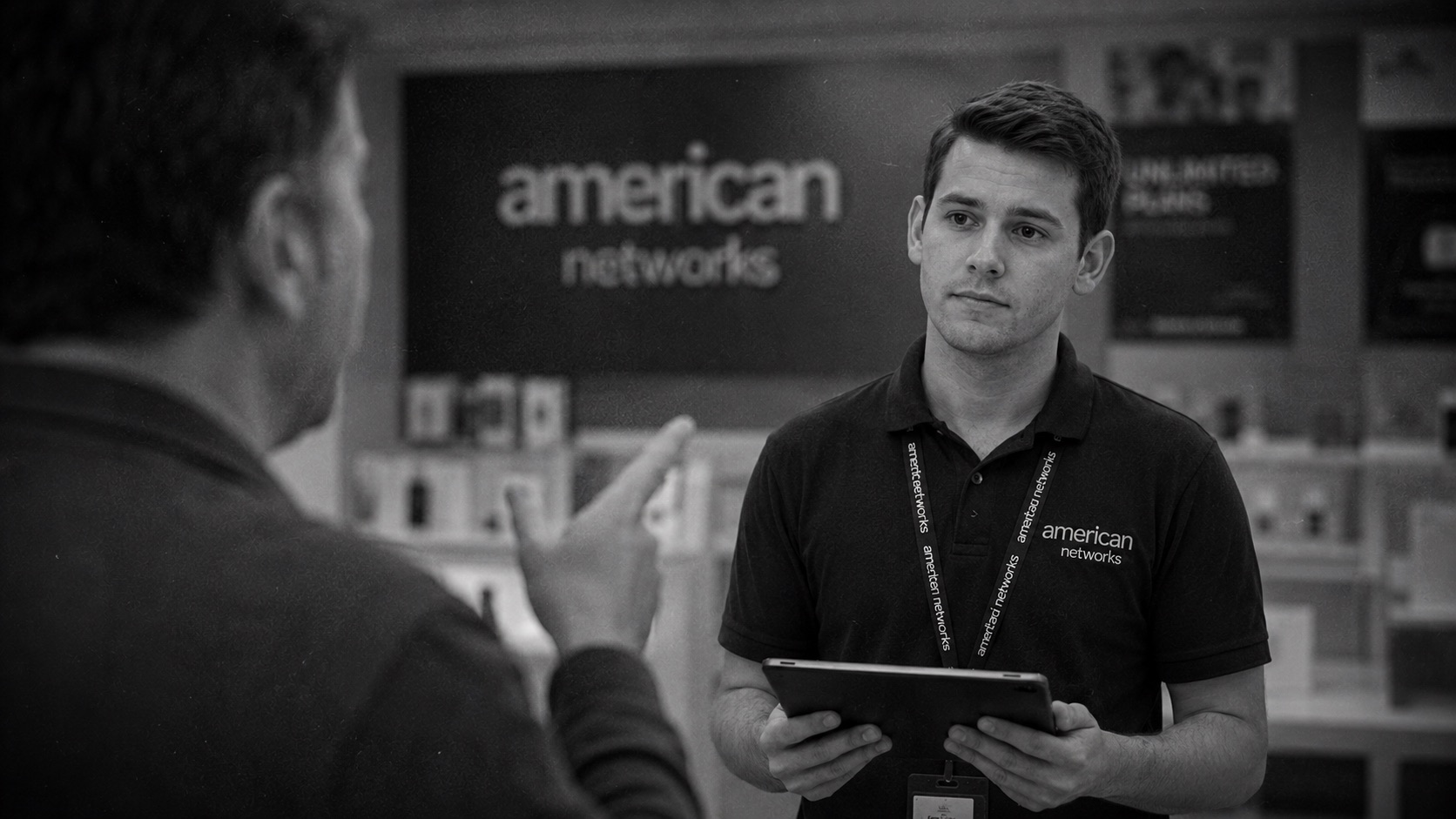
This case study recreates a project from my previous organization. To protect confidentiality, all screens,
research data, and testing data are reimagined from memory for this portfolio.
Background
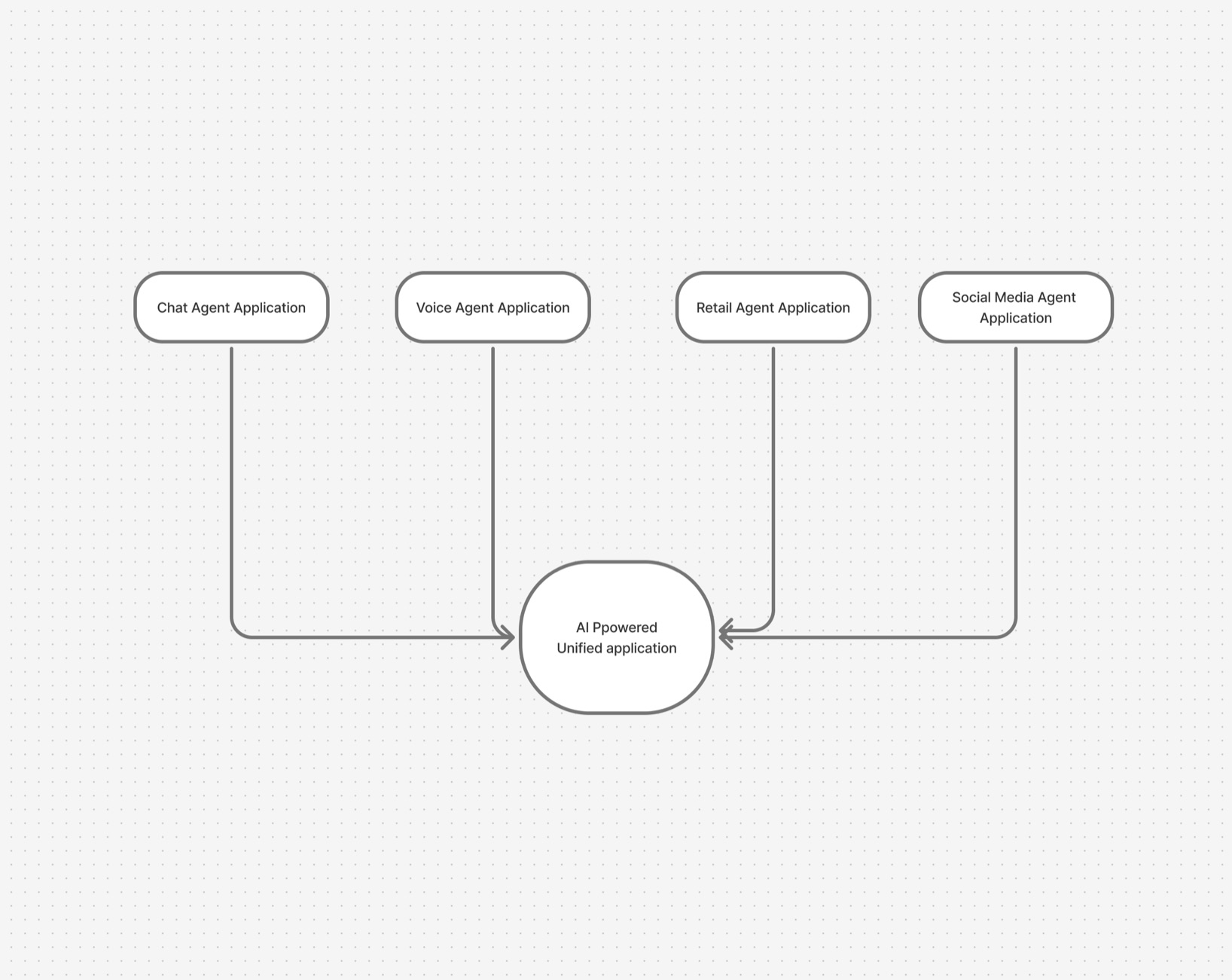
Support agents handled customers across chat, call, social media, and retail, each channel running on a separate application, most nearly a decade old. Partial revamps over the years led to feature creep: slow, cluttered tools where finding a feature was nearly impossible, and systems that broke down mid interaction.
Under that pressure, agents made more mistakes, extending resolution times further. Customers arrived already frustrated, only to encounter agents struggling with their own tools instead of solving the issue. The organisation planned to revamp the entire range of applications into one unified experience.
My responsibility was the conversational AI that helps agents support the customer.
Agents are the real users. Customers are the end beneficiaries.
Live prototype
How I solved it — research
The biggest challenge was identifying what stakeholders actually needed: a high fidelity, futuristic bot, or something constrained by real limitations. I consolidated past usability studies, forum complaints, agent interviews, and support call recordings, used Gemini and NotebookLM to synthesise findings into stakeholder-ready material, then ran a workshop to align on direction. Every resulting idea was weighed against three constraints.
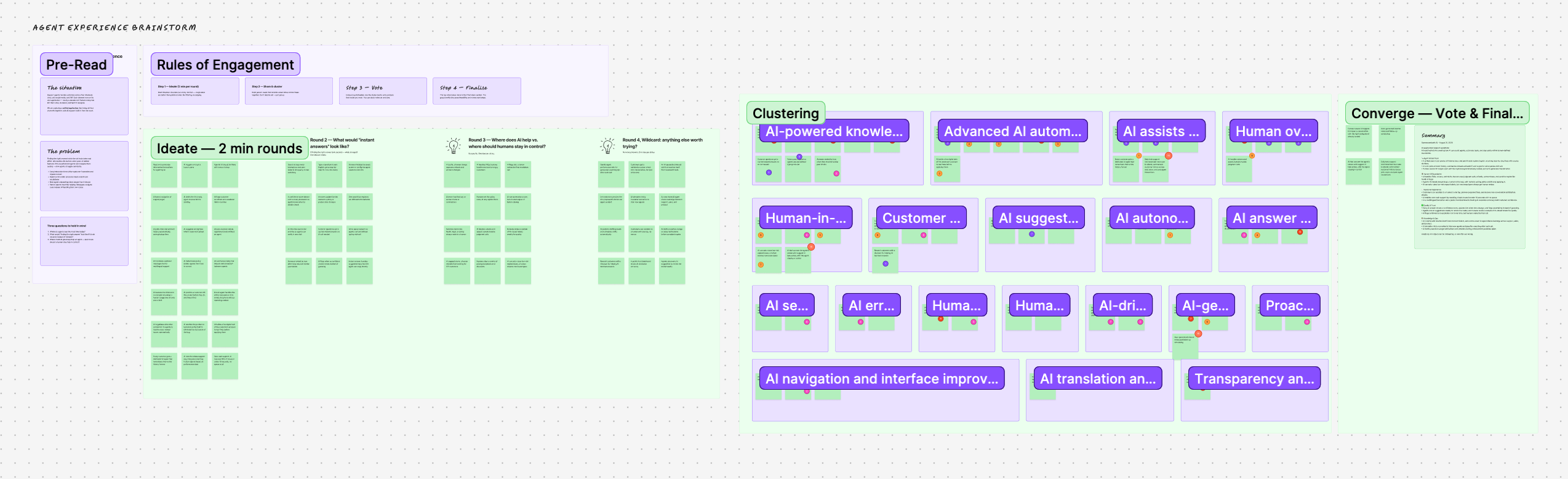
Leadership wanted a fast, visible win. Screen aware AI had to prove it saved minutes, not just look impressive. Any feature had to work across all four channels.
Legacy systems could not expose a clean API for full screen access. The LLM search capability already existed, reuse over rebuild.
Screen aware AI could not capture payment data. No AI action could message a customer without a human sending it.
What we chose not to build
Agentic AI that could message customers without review.
Privacy and security would not approve unsupervised outbound messages, so every AI action stays in a draft and approve state.
Full screen recording sent to a third party AI vendor.
Legal flagged the data residency risk, so screen aware AI reads structured fields only, inside the existing data boundary.
A brand new UI built from scratch for the AI layer.
Engineering had no runway for a parallel build, so we extended the existing design system instead.
Designing the experience
Agents followed a strict linear path from point A to B, even when several stages were already complete. That insight became the core design principle: let AI identify what is already done, and only surface the remaining actions.
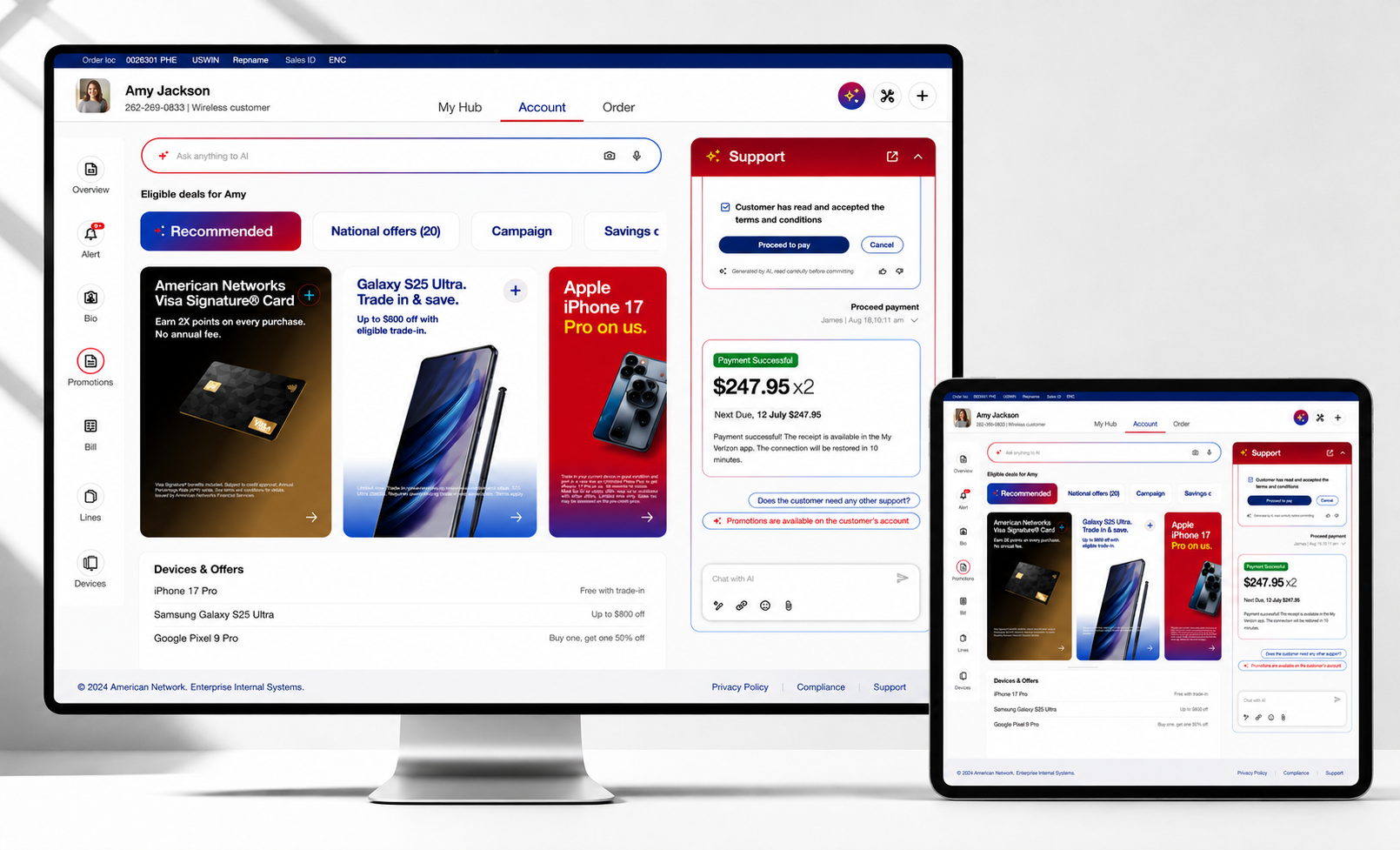
can see the agent's screen and suggest or take action, with the agent always staying in control
open a conversation with the right background already loaded
recommended next case to attend, with summarised customer history across web, store, and past interactions
internal notes and follow-up scheduling created automatically
personalised learning suggestions based on an agent's past interaction patterns
I collaborated with channel teams on the unified application. I defined personas by agent tenure and mapped journeys for common cases. A key insight emerged: agents followed a strict path from A to B, with no option to skip ahead. This became a design principle: let AI identify completed actions and show remaining tasks.
Design system
The organisation already had a brand, a core design system, and a conversational design expansion pack. I worked directly with the design systems team to introduce new components and update existing ones, keeping everything consistent with the wider product.
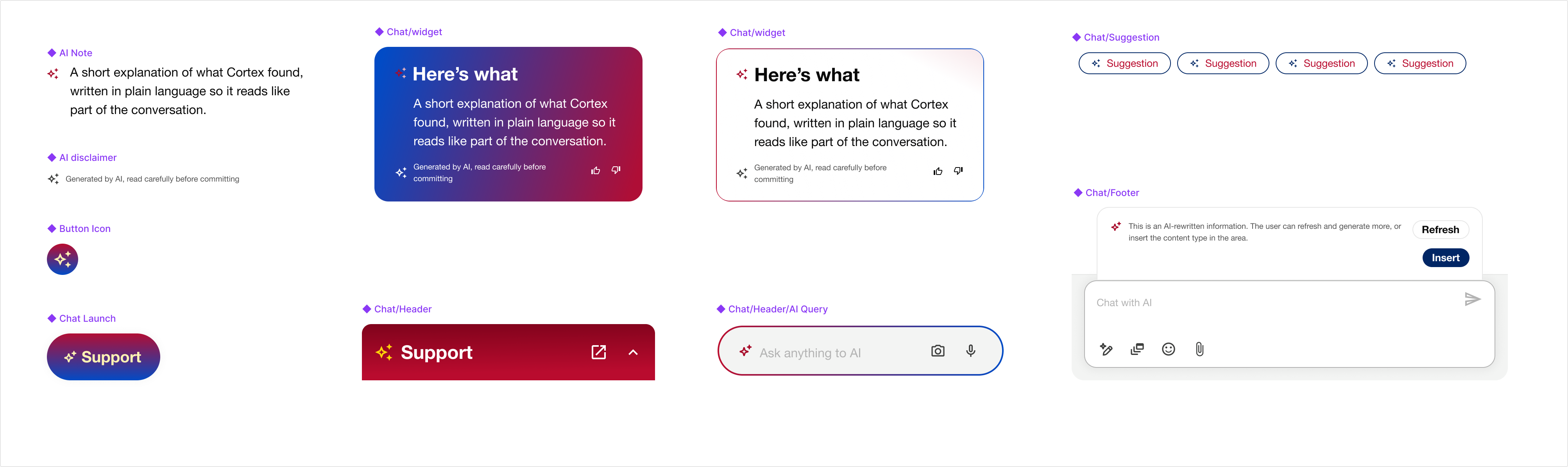
What these looked like
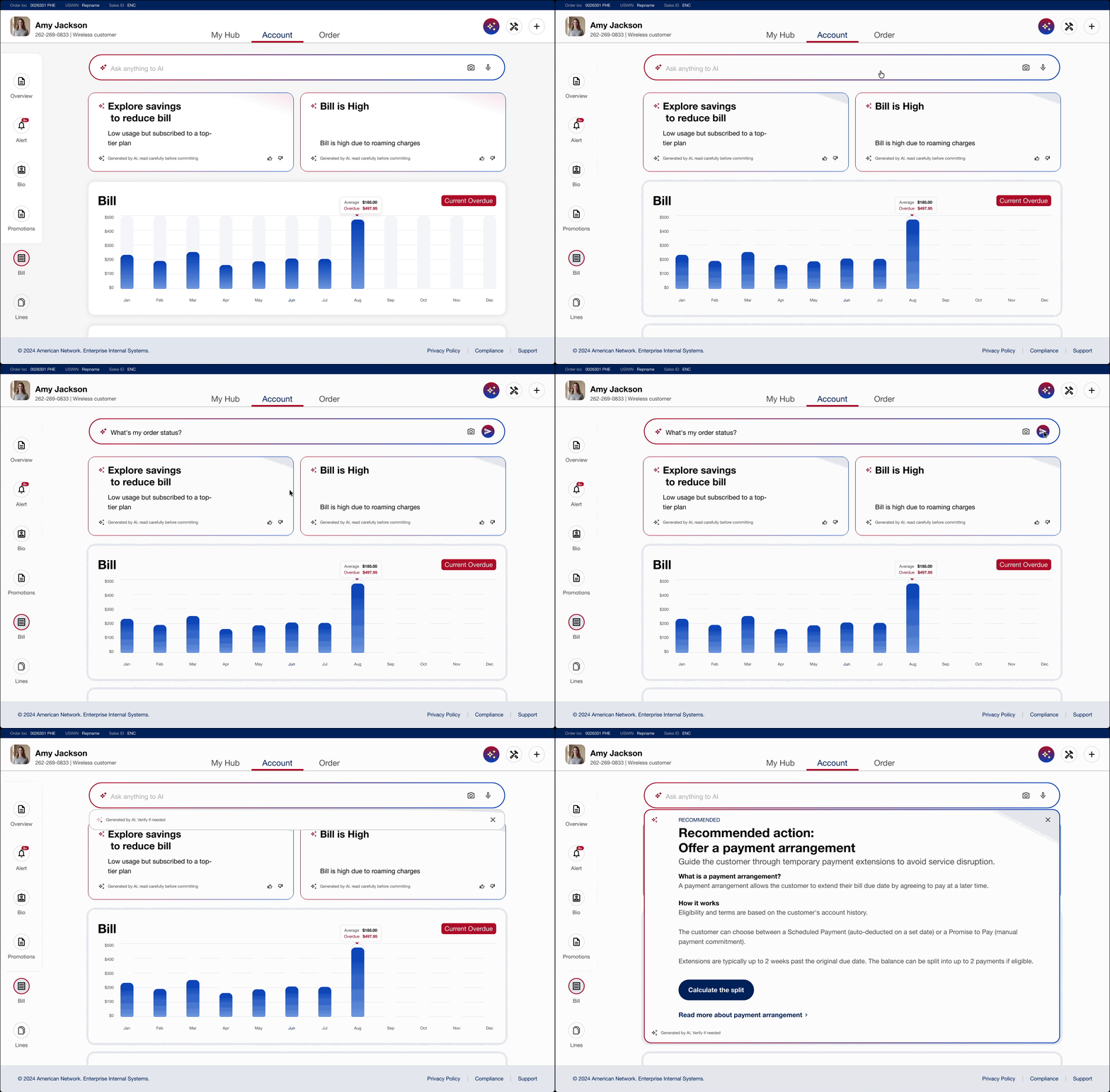
A few of the ideas from the sticky notes made it into shipped screens. Here is what they looked like once built.
Reads context, recommends a next step in draft form.
Follow up scheduling and session summary, automatic.
Session close, satisfaction captured, next steps surfaced.
Testing with real agents
A usability study with real agents confirmed the direction, but surfaced a real concern: agents wanted transparency into AI actions, and some wanted more autonomy from the AI, not less. That tension shaped later iteration.
Agent, 6 years tenure
Agent, 1 year tenure
Agent, 15 year tenure
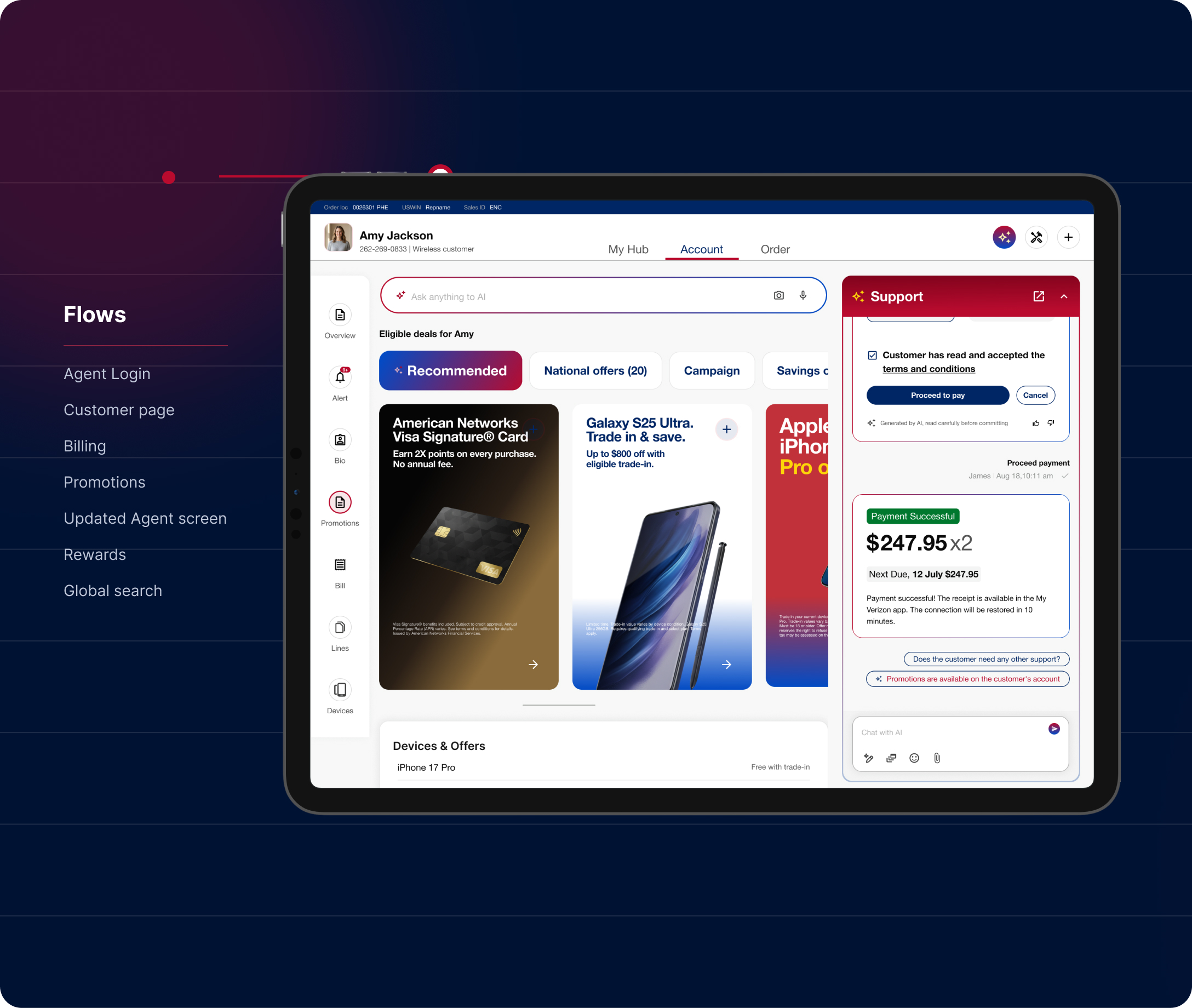
The shipped experience
Based on testing feedback, I made targeted changes to the flow and worked with AI tools to align conversation content with the brand's tone of voice at scale, then stayed closely involved through build, reviewing implementation against spec.
What happened after shipping
Interaction time
Hours to minutes
Down, after replacing four separate tools with one
Training time
One app, not four
New and existing agents onboard on a single interface
Training cost
Generic to personalised
AI curates a module from each agent's own interactions
Customer experience
Less waiting, less frustration
A natural result of cutting interaction time to minutes
Reflection
The hardest part of this project was not the interface. It was getting a decade of accumulated complexity down to something an agent could trust in the middle of a live, frustrated customer conversation. AI helped at two levels: inside my own process, to move faster through research and synthesis, and inside the product, to remove steps an agent no longer needed to do by hand.
The open question the team is still working through: how much should the AI act on its own, and how much should it stay a suggestion the agent approves. Agent feedback made clear this line matters more than any single feature.